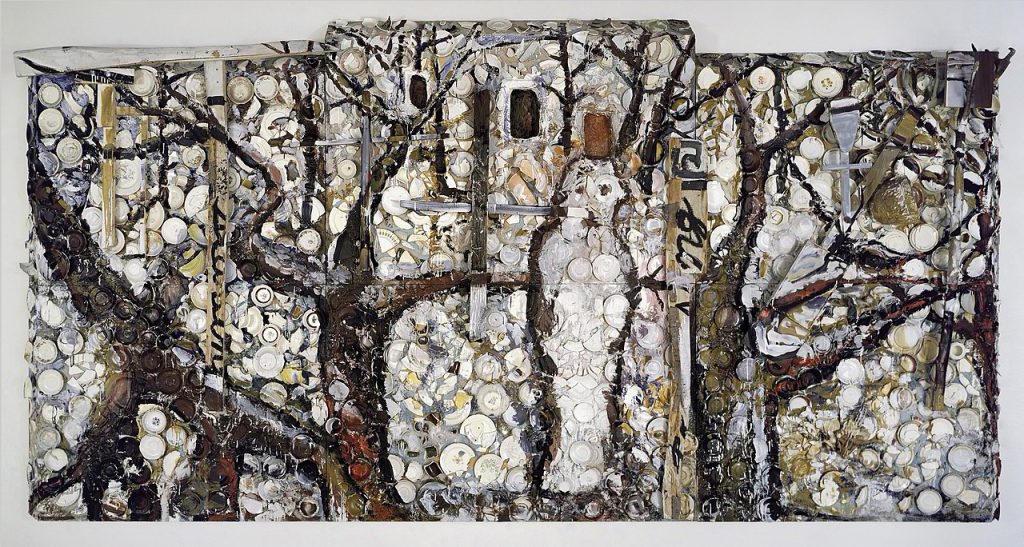
Maximalism in essence is the direct opposite of minimalism. Applying this within your design ethos ensures a must for the incorporation of more visual elements; colours, patterns, textures and decoration (Andrews 2020). Within Maximalist design is an assortment of complex shapes, colours and assets to fill out the canvas or space. While minimalism strives to use negative space, maximalism does not follow that same belief. The Artwork by Julian Schnabel “The Student of Prague” fills the canvas with a use of Oil, Plates, Horns, and Bondo on wood. There is a mass use of these components which causes the eye to be drawn to each individual part of the display that can become an assault on the eyes, but overall brings a feeling of togetherness as each section is as important as the last.
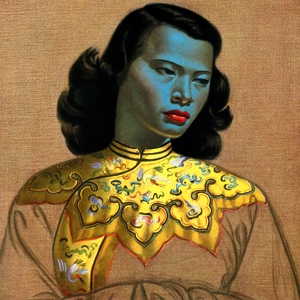
Kitsch is a design that is directly associated with bad taste, received in popularity by those that genuinely feel it is good and those that relish in the awful aspects of it. Those that perceive themselves as the guardians of good taste, designate that which they view in bad taste as “kitsch” (Walker 1938). This direct art form stems from the view of it being in bad taste, but it has a following and support from various people of all different beliefs and views. Kulka (2015) argues that Kitsch has seen an increasing growth in popularity since the second half of the 19th Century. A look at a piece of art believed to be one of the most popular artworks of a kitsch style. Chinese Girl (1950) by Vladimir Tretchikoff is argued to be one of the most reproduced fine art prints in the world (Smith 2013). There is an argument on if this could really be described as bad taste. What parameters define bad taste when there are people that enjoy it.
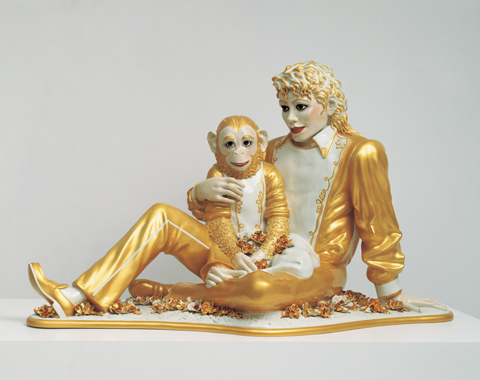
To acknowledge kitsch is to acknowledge prominent artists that can adopt this method and turn it into phenomenal pieces that can impact the art world. Jeff Koons has had his work featured in multiple international exhibitions and galleries (Gallery 2014). The kitsch inspired piece done by Jeff Koons “Michael Jackson and Bubbles” (1988) is just a brief look into how these overall different and contrasting styles that challenge the norm of good taste and standard aesthetics can still be appealing and receive heightened appraisal. It is key to appreciate that Jeff Koons engagement within social, technological, and economical currents have made him such a defining artist. (Rothkopf 2014)
References
Andrews, E., 2020. Maximalist Design For Food Branding.
Gallery, G., 2014. Jeff Koons: New Paintings & Sculpture.
Graff Diamonds 2013 “Tretchikoff’s Chinese Girl Unveiled as Delaire Graff Estate” Available Online https://www.graffdiamonds.com/archives/tretchikoffs-chinese-girl-unveiled-at-delaire-graff-estate/
Koons, J. 1988 Porcelain Michael Jackson and Bubbles Jeff Koons. Photo Available online http://www.jeffkoons.com/artwork/banality/michael-jackson-and-bubbles
Kulka, T., 2015. Kitsch and art. Penn State Press.
Rothkopf, S., 2014. Jeff Koons: a retrospective. Yale University Press.
Schnabel, J 1983. (Painting) “The Student of Prague” Guggenheim Museum, Available Online https://www.guggenheim.org/artwork/20404
Smith, D. 2013 The Guardian “I never made money from the Green Lady” says Tretchikoff’s model. Available online https://www.theguardian.com/artanddesign/2013/feb/09/green-lady-monika-pon
Walker, J 1938 Design History and the History of Design. London