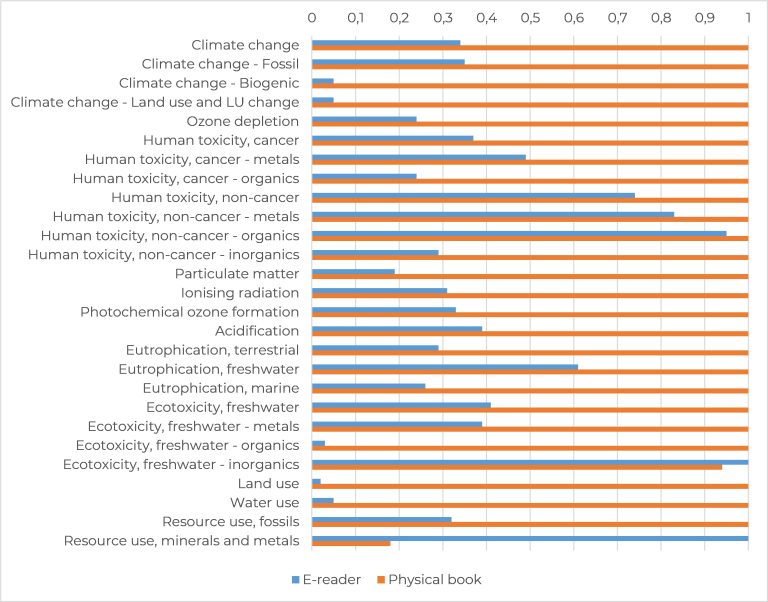
To acknowledge the writer’s stance on this subject is to appreciate the variables within the information and how delicately the favour can change within either side. The argument of E-readers vs Books is one that could be skewed in favour of the other dependant on the information presented; an article written by Carla Delgado (2022) for popular science, displays a series of studies that all discovered a varying degree of results on how many books it would take to offset and e-readers carbon footprint. The key aspect is that each one has different variables it takes into consideration, but this becomes defining as a notion that the carbon footprint can be offset. To give a specific view of how this approach will dictate the final product there is a study done by The Hedgehog Company, who are self described as a company that guides organisations towards sustainability, they determined that over the course of a five year period, if a reader were to read more than 25 books that person could become more environmentally friendly by doing so through the use of an e-reader. (2021) The conditions of this study involved a single e-reader vs 120 books that were disposed of and recycled at the end; the e-reader was disposed of after the five year process and the results were displayed in a chart of the environmental impact of each. This was done in an ideal scenario but does not incorporate the factors of how in an average situation a book could not be recycled, or even thrown out in the first place. It also does not claim any acknowledgement of how a user may upgrade their E-reader quicker than a five year period.